Science › Occultations & Transits
Haumea occultation
A stellar occultation by the dwarf planet (136108) Haumea on 4 May 2026, recorded from Abu Dhabi as part of an international campaign coordinated with Dr. José Luis Ortiz (IAA-CSIC) and the Lucky Star team.
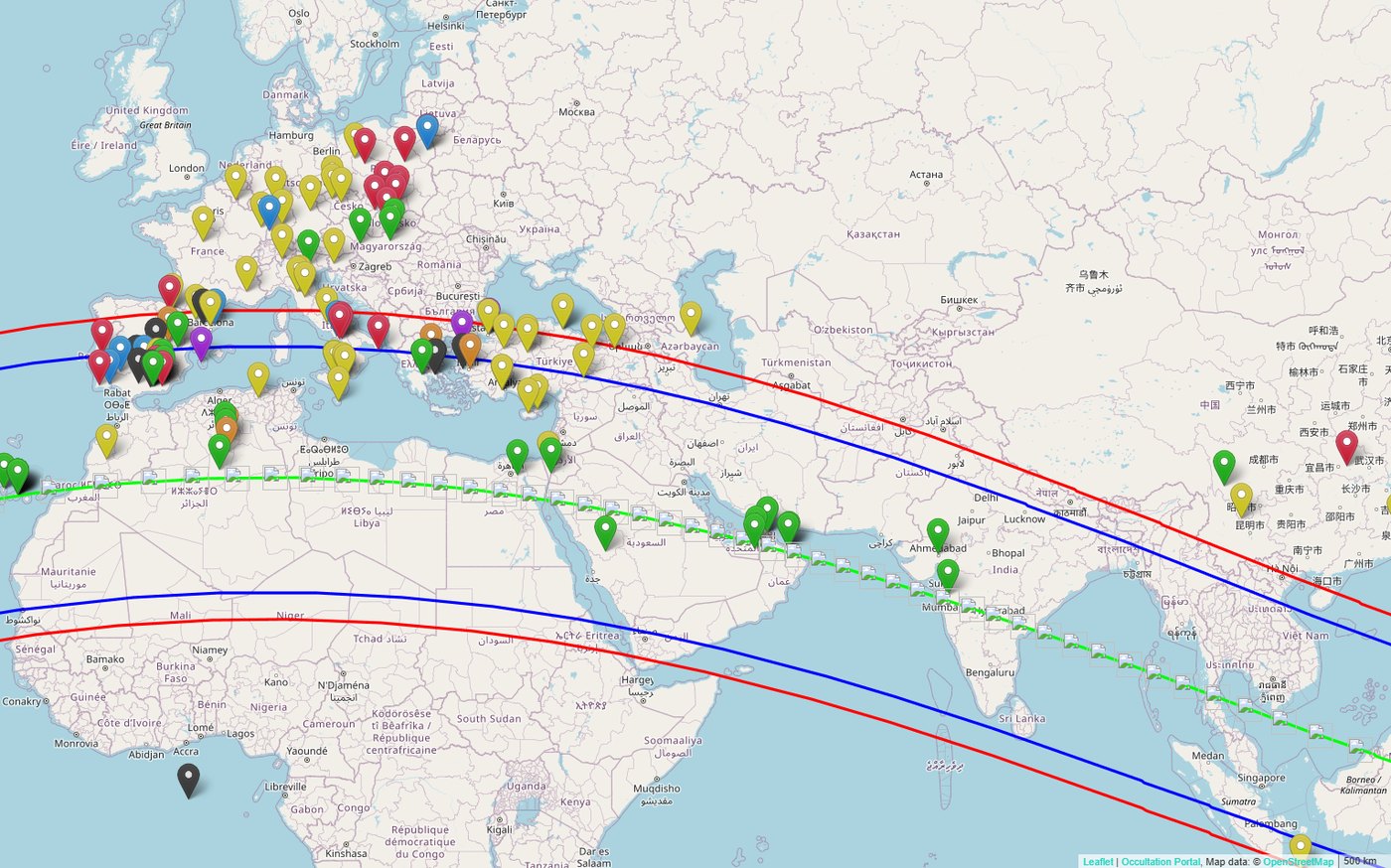
Where it was seen
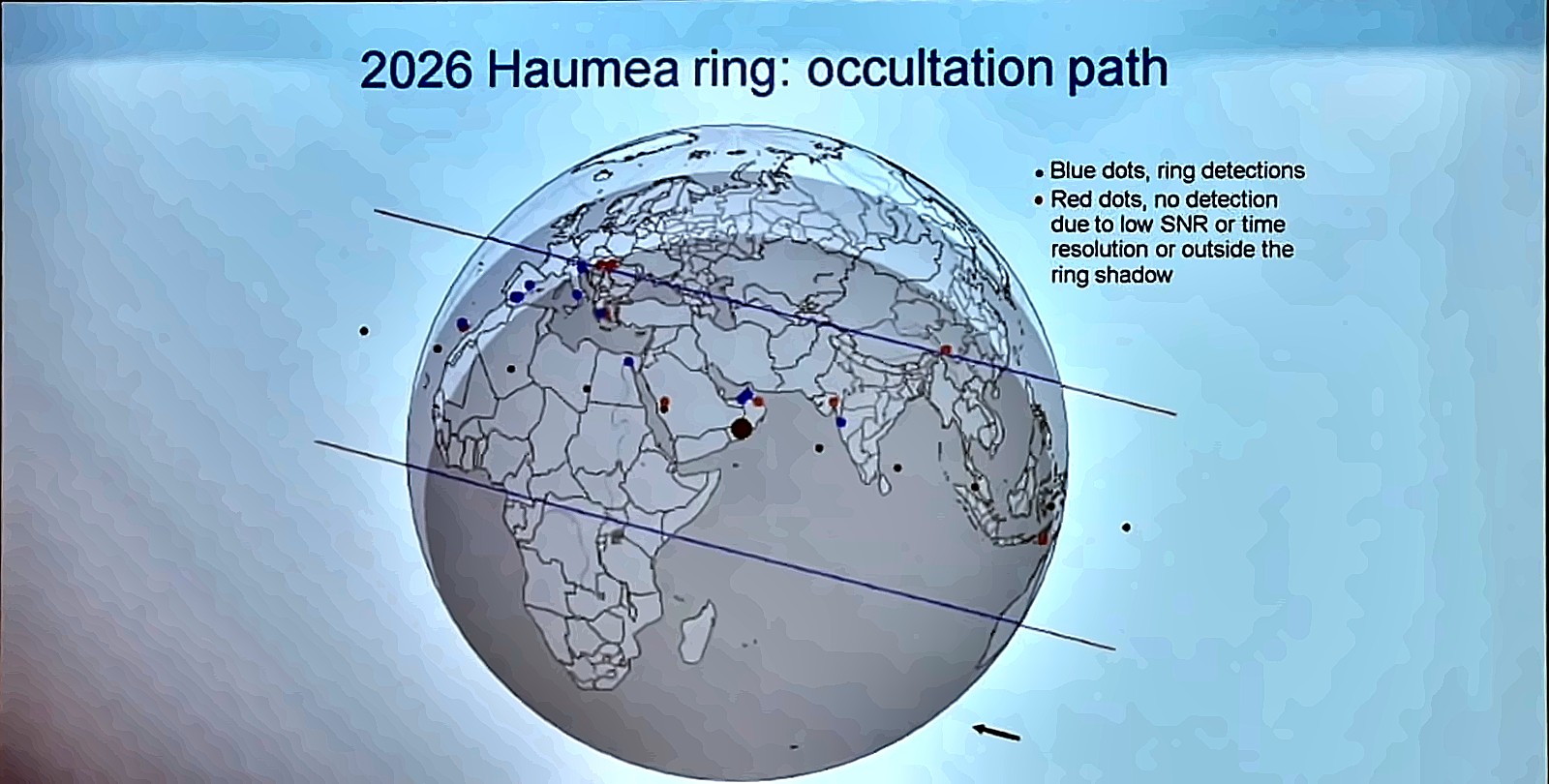
The shadow of Haumea crossed Europe, North Africa, the Middle East and Asia on 4 May 2026. Each marker below is an observing station; Jovian Observatory is one of the positive chords in the UAE.
The event
Haumea is a fast-spinning, elongated dwarf planet beyond Neptune. Its ring was discovered through a stellar occultation in 2017, and every new event gives a rare chance to measure the body and the ring directly. On 4 May 2026 Haumea passed in front of a star and its shadow swept across Europe, North Africa, the Middle East and Asia, including the UAE.
I recorded the event from Jovian Observatory (M74) in Abu Dhabi with Sahil Purabiya, using a 30 cm Ritchey–Chrétien telescope. The star disappeared for under a minute and then returned, and the light curve shows the small drops in light that come from the ring, before and after the occultation by the main body. My data supported the detection of Haumea’s ring.
Tycho Tracker animation of the event, playing on a loop. In the inset at the lower right, the star fades out during the occultation and returns afterwards.
The light curve
Photometry was measured in AstroImageJ and normalised to the star’s out-of-event level. The dashed red lines mark the predicted ingress and egress. Time is geocentric Julian Date (UTC) minus 2461165.
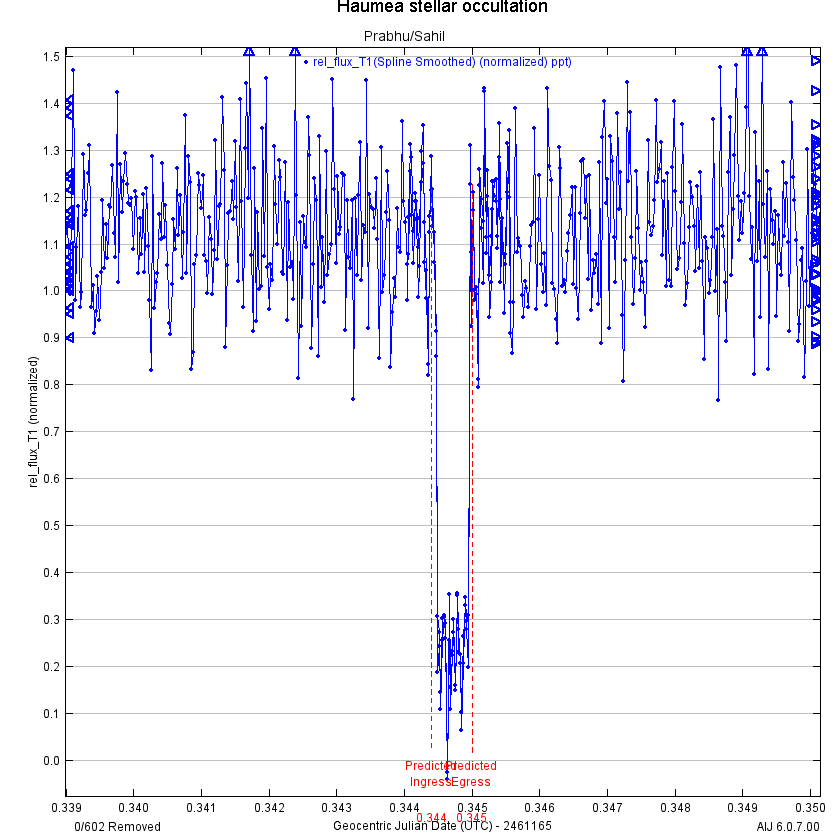
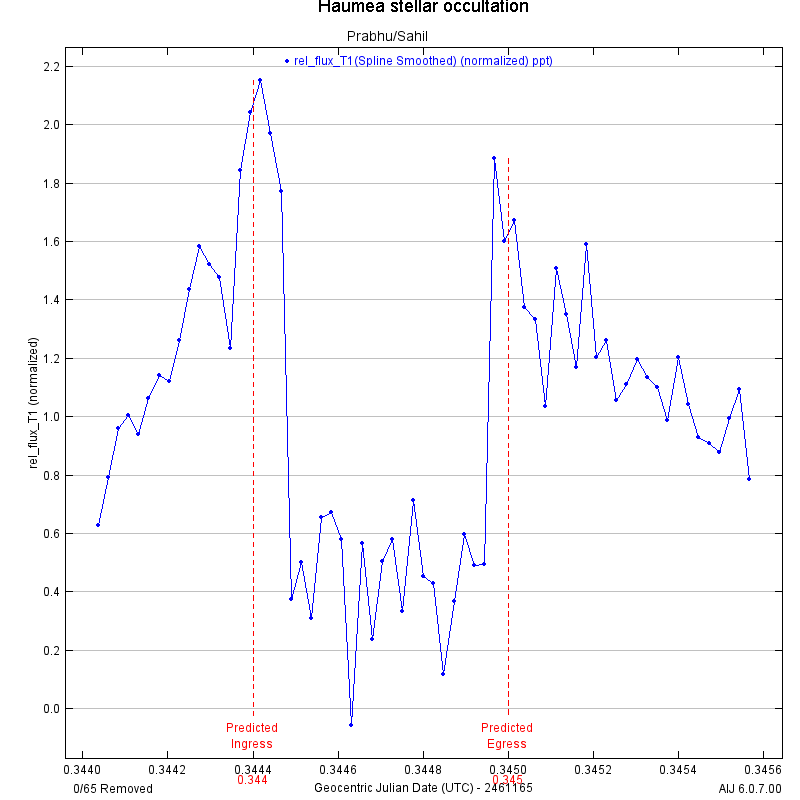
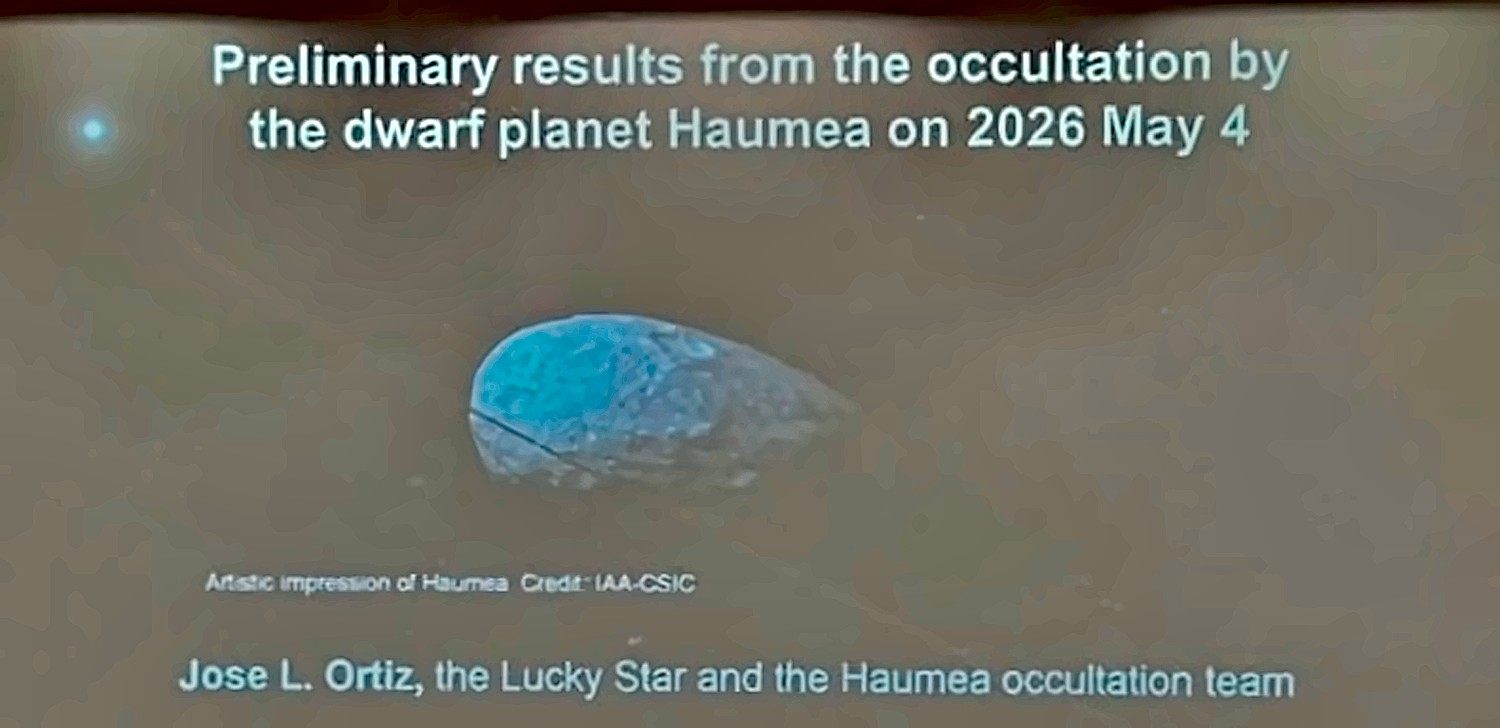
Dr. José Luis Ortiz, who coordinated the campaign, wrote that the light curve is a very good one: the faint dips from the ring can be seen on both sides of the main-body event. He also complimented the quality of the work, and the observation was shown in his preliminary-results presentation.
The campaign
Beyond the map, the event was covered by stations along the whole path. Besides Jovian Observatory, the Occultation Portal lists positive chords from the UAE Mountain Site and from Al-Fulaij Observatory in Oman, along with negative results, clouded-out stations and technical failures elsewhere.
Observation details
- Target
- (136108) Haumea, stellar occultation
- Date and time
- 4 May 2026, about 20:15 UT
- Site
- Jovian Observatory (M74), Abu Dhabi, UAE
- Observers
- Prabhakaran Andiappan, Sahil Purabiya
- Telescope
- 304 mm (12 inch) Ritchey–Chrétien, f/5.36
- Camera
- ZWO ASI294MM Pro (CMOS), field of view 26.8′ × 26.9′
- Filter and exposure
- Antlia 550 nm, 1.5 s per frame
- Software
- Tycho Tracker (video), AstroImageJ 6 (light curve)
- Result
- Positive detection, submitted to the Occultation Portal
Data and references
The observation is archived on the Occultation Portal. The prediction paper for this event and for future Haumea occultations through 2030 is by Ortiz et al., Monthly Notices of the Royal Astronomical Society, 548(2), 2026.
Light curves, video and observation details: Jovian Observatory. Chord map: Occultation Portal (OPoP), map data © OpenStreetMap contributors. Slides: J. L. Ortiz / IAA-CSIC and the Lucky Star team. Thanks to Dr. José Luis Ortiz and the Haumea occultation team for coordinating the campaign.